Faced with a beam catalogue, the temptation is to pick "the one with the right height". That is the surest way to pay for too much steel — or worse, to under-size. Each profile family was designed for a specific mode of loading. This guide explains which, with dimension tables for the profiles most requested in Morocco.
Reading a profile designation
A designation such as IPE 240 reads in two parts: the letters give the family — hence the section shape — and the number gives the nominal height in millimetres.
- I: I-section, two flanges joined by a vertical web.
- PE: parallel European flanges, of constant thickness.
- PN: normal flanges, tapered, thicker near the web.
- HE: wide-flange profile, whose width approaches its height.
- U: channel section, open on one side.
The A or B suffix on HE profiles indicates thickness: HEA is the lighter version, HEB the reinforced one at comparable height. A HEB 200 weighs 61.3 kg/m against 42.3 kg/m for a HEA 200 — 45 % more material for the same overall height.
Steel grades follow EN 10025. S235 (yield strength 235 MPa) covers most ordinary buildings; S275 and S355 allow lighter sections on long spans, at a higher price per kilo.
IPE and IPN: the bending profiles
Both profiles have a narrow, tall section. That geometry concentrates material far from the neutral axis, where it resists bending best: these are beam profiles par excellence.
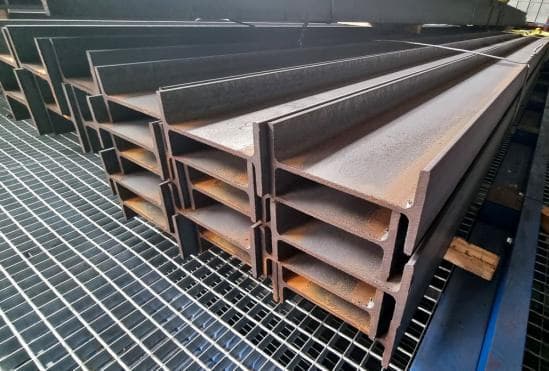
IPE is today's standard. Its parallel flanges simplify everything: bolted connections sit flat without tapered washers, and end plates weld on without fitting cuts.
IPN, with its tapered flanges, is the historic profile. It is still used in refurbishment, to connect to an existing structure, and in some handling applications.
| Profile | h (mm) | b (mm) | Weight (kg/m) | Weight of a 6 m bar |
|---|---|---|---|---|
| IPE 100 | 100 | 55 | 8.1 | 48.6 kg |
| IPE 120 | 120 | 64 | 10.4 | 62.4 kg |
| IPE 140 | 140 | 73 | 12.9 | 77.4 kg |
| IPE 160 | 160 | 82 | 15.8 | 94.8 kg |
| IPE 180 | 180 | 91 | 18.8 | 112.8 kg |
| IPE 200 | 200 | 100 | 22.4 | 134.4 kg |
| IPE 220 | 220 | 110 | 26.2 | 157.2 kg |
| IPE 240 | 240 | 120 | 30.7 | 184.2 kg |
| IPE 270 | 270 | 135 | 36.1 | 216.6 kg |
| IPE 300 | 300 | 150 | 42.2 | 253.2 kg |
| IPE 330 | 330 | 160 | 49.1 | 294.6 kg |
| IPE 360 | 360 | 170 | 57.1 | 342.6 kg |
| IPE 400 | 400 | 180 | 66.3 | 397.8 kg |
| IPE 450 | 450 | 190 | 77.6 | 465.6 kg |
| IPE 500 | 500 | 200 | 90.7 | 544.2 kg |
| IPE 600 | 600 | 220 | 122.0 | 732.0 kg |
A few common IPN sizes for comparison: IPN 100 → 8.34 kg/m; IPN 140 → 14.3 kg/m; IPN 200 → 26.2 kg/m; IPN 300 → 54.2 kg/m.
HEA and HEB: the compression profiles
HE profiles have a flange width close to their height — a HEB 200 measures 200 × 200 mm. That near-square section gives comparable stiffness in both directions, which is exactly what a column needs: it must resist buckling whichever way it might go.
An IPE used as a column, by contrast, is very stiff in one plane and very flexible in the other. It buckles about its weak axis long before exhausting its strength.
HEA or HEB? HEA is enough for moderate loads and lightens the structure. HEB, thicker, is the choice for heavily loaded columns, long-span portal frames, and anywhere stiffness governs.
| Profile | h × b (mm) | HEA (kg/m) | HEB (kg/m) | Difference |
|---|---|---|---|---|
| 100 | 96×100 / 100×100 | 16.7 | 20.4 | +22 % |
| 120 | 114×120 / 120×120 | 19.9 | 26.7 | +34 % |
| 140 | 133×140 / 140×140 | 24.7 | 33.7 | +36 % |
| 160 | 152×160 / 160×160 | 30.4 | 42.6 | +40 % |
| 180 | 171×180 / 180×180 | 35.5 | 51.2 | +44 % |
| 200 | 190×200 / 200×200 | 42.3 | 61.3 | +45 % |
| 220 | 210×220 / 220×220 | 50.5 | 71.5 | +42 % |
| 240 | 230×240 / 240×240 | 60.3 | 83.2 | +38 % |
| 260 | 250×260 / 260×260 | 68.2 | 93.0 | +36 % |
| 300 | 290×300 / 300×300 | 88.3 | 117.0 | +33 % |
Note that a HEA's actual height is less than its number: a HEA 200 is 190 mm tall. The HEB is exactly square. That detail matters when aligning levels.
UPN: the edge profile
The open channel only works well in bending about one plane, and it twists readily as soon as the load is not centred on the web. So it is neither a column nor a primary beam.
Its flat face, however, makes it ideal wherever something needs edging: roof purlins, trimmers, opening surrounds, dock edging, guide rails and wall-fixed supports.
Some benchmarks: UPN 80 → 8.64 kg/m; UPN 100 → 10.6 kg/m; UPN 120 → 13.4 kg/m; UPN 140 → 16.0 kg/m; UPN 160 → 18.8 kg/m; UPN 180 → 22.0 kg/m; UPN 200 → 25.3 kg/m; UPN 240 → 33.2 kg/m; UPN 300 → 46.2 kg/m.
Two UPN welded back to back form a very efficient closed section, often used as a post where a HEA would be oversized.
Choosing in three questions
1. Does the member work in bending or compression?
Bending (it carries a load between two supports) → IPE. Compression (it transmits a vertical load) → HEA or HEB.
2. Is the load centred?
If it arrives as a cantilever or at the edge of the profile, torsion governs. A closed section — rectangular tube, or two coupled UPN — resists far better than an open profile.
3. What length should you order?
Beams are supplied in 6 and 12 m. Buying 12 m to cut two 5.80 m pieces generates 40 cm of offcut per bar; buying two 6 m bars avoids the offcut but doubles the handling. The sum is done case by case, including transport cost.
One last point found in no table: the final choice of section belongs to a structural calculation, accounting for actual loads, spans, bracing and applicable regulations. The tables above are there to prepare a consultation and understand a quotation — not to size a structure.
Frequently asked questions
What is the difference between IPE and IPN?
IPE has parallel flanges of constant thickness; IPN has tapered flanges, thicker near the web. IPE is today's standard because its flat flanges simplify connections; IPN remains in use for refurbishment and handling applications.
HEA or HEB: which should I choose?
At equal nominal height, HEB is thicker and heavier — by 22 to 45 % depending on size. HEA suits moderate loads and lightens the structure; HEB is the choice for heavily loaded columns and long-span portal frames.
Can an IPE be used as a column?
It is not advisable for a free-standing column. The narrow IPE section is very stiff in one plane and very flexible in the other: it buckles about its weak axis. HEA and HEB profiles, near-square in section, are made for this.
How much does a 6-metre IPE 200 weigh?
An IPE 200 weighs 22.4 kg per metre, so 134.4 kg for a 6 m bar and 268.8 kg for a 12 m bar.
Which steel grade for an ordinary frame?
S235 to EN 10025 covers most ordinary buildings. S275 and S355, with higher yield strength, allow reduced sections on long spans but cost more per kilo.
The values given in this guide are theoretical benchmarks drawn from the standards cited. They do not replace a structural calculation note, nor the manufacturer's documentation. For any sizing, have your assumptions validated by a design office.