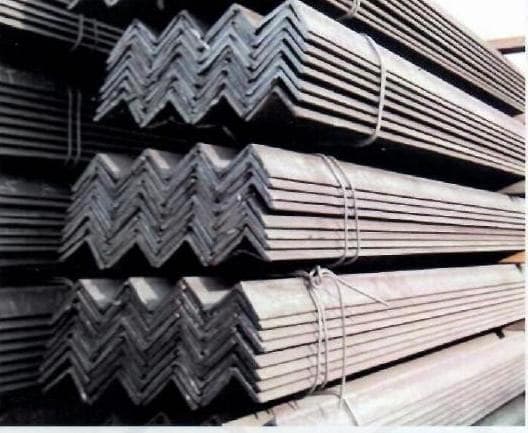
The angle is to the metalworker what the batten is to the joiner: the basic section, the one always in stock. Its L-shaped profile offers surprising stiffness for a modest weight, and it lends itself to everything — light framing, bracing, edging, supports. But you still need to know what each section weighs.
Reading an angle designation
An angle is designated by three numbers: L 50 × 50 × 5 means two 50 mm legs, 5 mm thick.
Two families exist:
- Equal legs (L a × a × t): the common case, by far the most widely stocked.
- Unequal legs (L a × b × t): one leg longer than the other, useful where the part must bear widely on one side while staying discreet on the other — a wall-fixed shelf bracket, for instance.
The reference standard is EN 10056 for dimensions and tolerances, and EN 10025 for steel grades. Almost all common angles are supplied in S235, in 6 m bars.
One detail that matters when cutting: the edges of a hot-rolled angle are slightly rounded, and the internal root radius takes up a few millimetres. An angle therefore never forms a perfectly sharp corner — worth allowing for in tight assemblies.
Weight of equal-leg angles
| Section | Weight (kg/m) | 6 m bar | Metres per tonne |
|---|---|---|---|
| L 20 × 20 × 3 | 0.88 | 5.3 kg | 1,136 m |
| L 25 × 25 × 3 | 1.12 | 6.7 kg | 893 m |
| L 30 × 30 × 3 | 1.36 | 8.2 kg | 735 m |
| L 30 × 30 × 4 | 1.78 | 10.7 kg | 562 m |
| L 35 × 35 × 4 | 2.09 | 12.5 kg | 478 m |
| L 40 × 40 × 4 | 2.42 | 14.5 kg | 413 m |
| L 40 × 40 × 5 | 2.97 | 17.8 kg | 337 m |
| L 45 × 45 × 5 | 3.38 | 20.3 kg | 296 m |
| L 50 × 50 × 5 | 3.77 | 22.6 kg | 265 m |
| L 50 × 50 × 6 | 4.47 | 26.8 kg | 224 m |
| L 60 × 60 × 6 | 5.42 | 32.5 kg | 185 m |
| L 60 × 60 × 8 | 7.09 | 42.5 kg | 141 m |
| L 70 × 70 × 7 | 7.38 | 44.3 kg | 136 m |
| L 80 × 80 × 8 | 9.63 | 57.8 kg | 104 m |
| L 90 × 90 × 9 | 12.2 | 73.2 kg | 82 m |
| L 100 × 100 × 10 | 15.0 | 90.0 kg | 67 m |
| L 120 × 120 × 12 | 21.6 | 129.6 kg | 46 m |
| L 150 × 150 × 15 | 33.8 | 202.8 kg | 30 m |
Note the progression: moving from L 50 × 50 × 5 to L 50 × 50 × 6 adds 19 % of weight for the same footprint. That is often the best lever when a section is marginal — thickening before widening avoids reworking the whole geometry.
Which section for which use
L 20 to L 30 — light metalwork. Gate frames, grille frames, panel stiffeners, light supports. Beyond a metre without support, these sections deflect visibly.
L 40 to L 60 — everyday framing. This is the most used range: gate frames, metal furniture frames, cladding rails, ladders, guardrails. The L 50 × 50 × 5 is probably the best-selling angle across all uses.
L 70 to L 100 — structural. Frame bracing, lattice members in open-web beams, pylon uprights, supports carrying meaningful loads.
Above L 100 — heavy structure. Heavy frame connections, truss chords.
The bending trap
A lone angle loaded in bending behaves unusually: its principal axes of inertia are inclined at 45° to the legs. A vertical load on a single angle therefore causes biaxial bending accompanied by torsion — the section twists instead of simply deflecting in the plane of the load.
That is why angles rarely work alone as beams. They are either laterally restrained or assembled in pairs — back to back or crossed — which restores symmetry and removes the problem.
Ordering angles properly
Three points save time and avoid unpleasant surprises:
- Always state all three dimensions. Asking for "50 angles" is ambiguous: L 50 × 50 × 5 and L 50 × 50 × 6 differ by 19 % in weight, and therefore in price.
- Calculate in metres, order in bars. Angles are supplied in 6 m lengths. A 50 m requirement means 9 bars (54 m), not 8.33. Offcuts belong in the sum from the consultation stage.
- Plan the protection. A bare angle left outdoors rusts within weeks. Allow for galvanising after fabrication, or a paint system, from the design stage — stripping an erected structure costs far more than treating it flat.
Frequently asked questions
How much does a 50 × 50 × 5 angle weigh?
3.77 kg per metre, so 22.6 kg for a 6 m bar. One tonne represents about 265 metres of this section.
What is the difference between equal-leg and unequal-leg angles?
Equal legs (L a × a × t) form a symmetrical L, the most common case. Unequal legs (L a × b × t) have one longer leg, useful where the part must bear widely on one side while staying discreet on the other.
Which angle for a gate?
The L 40 to L 60 range covers the vast majority of gate frames. The L 50 × 50 × 5 is the most used section. The final choice depends on leaf dimensions, infill and fixing method.
Can an angle be used as a beam?
With care. The principal axes of inertia of an angle are inclined at 45° to the legs: a vertical load causes biaxial bending accompanied by torsion. Angles are generally laterally restrained or assembled in pairs.
The values given in this guide are theoretical benchmarks drawn from the standards cited. They do not replace a structural calculation note, nor the manufacturer's documentation. For any sizing, have your assumptions validated by a design office.