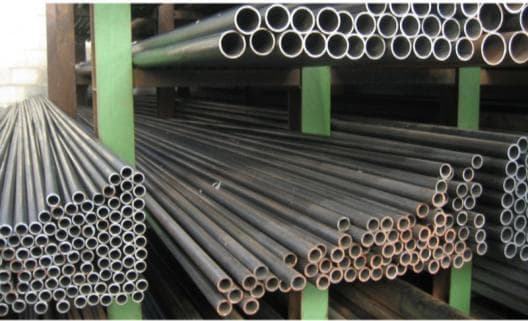
The tube is the most efficient section in light construction, and the reason fits in one sentence: in a member that bends, material near the centre does almost nothing. The tube removes it and moves it to the perimeter. Here is what that changes in practice, and how to calculate what you are ordering.
Why a tube beats a solid bar
The bending stiffness of a member depends on its second moment of area, which grows with the square of the material's distance from the neutral axis. A fibre 20 mm from the centre contributes four times more than one at 10 mm.
The consequence: material near the axis is nearly useless in bending. Hollowing it out and redistributing it to the perimeter raises stiffness without adding a gram.
The arithmetic is striking. Compare two members of identical cross-sectional area, hence identical weight per metre:
| Member | Area | Second moment of area | Relative stiffness |
|---|---|---|---|
| Solid round Ø 20 mm | 314 mm² | 7,854 mm⁴ | 1 × |
| Tube Ø 40 mm, 2.7 mm wall | 314 mm² | 54,978 mm⁴ | 7 × |
At strictly equal weight, the tube is seven times stiffer. It is one of the rare situations in construction where you gain without trade-off — other than price per kilo, slightly higher for a tube than for a solid bar.
Structural hollow sections fall under EN 10219 for cold-formed profiles and EN 10210 for hot-finished ones.
Calculating weight per metre
All three formulas follow the same principle: cross-sectional area (in mm²) × 0.00785.
Round tube — outside diameter D, wall t
kg/m = 0.0247 × t × (D − t)
Example, tube Ø 42.4 × 2.6: 0.0247 × 2.6 × 39.8 = 2.55 kg/m
Square tube — side a, wall t
kg/m = 0.0314 × t × (a − t)
Example, tube 50 × 50 × 3: 0.0314 × 3 × 47 = 4.43 kg/m
Rectangular tube — sides a and b, wall t
kg/m = 0.0157 × t × (a + b − 2t)
Example, tube 80 × 40 × 3: 0.0157 × 3 × 114 = 5.37 kg/m
One important caveat: these formulas assume sharp corners. Cold-formed square and rectangular tubes have corner radii at all four corners, which remove a little material. The calculated figure is therefore slightly above the real weight — by roughly 2 to 4 % on small sections, where the corner radius is proportionally larger. For a quotation, use the mill catalogue value; for an estimate, the formula is ample.
Which shape for which use
Round tube. The stiffest at equal weight, and the only one that behaves identically in every direction. Ideal for free-standing posts, handrails, masts and tubular structures. Its drawback is practical: any end-to-end joint needs a saddle cut, and nothing fixes to it flat.
Square tube. The most widely used compromise in metal joinery. Almost as efficient as the round, but with four flat faces: cuts are straight, corner welds simple, and any accessory screws on without an adaptor. That is what makes it the default section for gates, furniture, partitions and light frames.
Rectangular tube. For when loads come mainly from one direction. Laid on its side it is stiff vertically and more flexible laterally. It is the section for rails, lintels, trailer beds and purlins — wherever the load is clearly vertical.
The point to watch: orienting a rectangular tube the wrong way divides its stiffness by a large factor. An 80 × 40 laid "flat" (80 mm horizontal) is markedly more flexible than the same tube set "on edge" (80 mm vertical). The mistake is easy to make during erection, and expensive to correct.
Black or galvanised: the tube's special case
A tube raises a question solid sections do not: the inside.
An open tube exposed to rain fills with water. It sits there, never dries, and corrodes the tube from the inside out — invisible until it perforates. It is the leading cause of failure in tubular handrails, gates and fences.
Three complementary answers:
- Close the ends. Plastic caps, welded plates, or a sealing weld.
- Drill a drain hole at the low point of each run, to release the condensation that forms in a sealed tube anyway.
- Choose galvanised tube — checking that the galvanising actually covers the inside, which is not true of every process.
On a coastal outdoor structure, these three measures are not redundant: they stack.
Frequently asked questions
How do I calculate the weight of a square tube?
kg/m = 0.0314 × wall thickness × (side − wall thickness), in millimetres. A 50 × 50 × 3 tube weighs 0.0314 × 3 × 47 = 4.43 kg/m. The formula ignores corner radii and therefore slightly overstates, by 2 to 4 % on small sections.
How do I calculate the weight of a round tube?
kg/m = 0.0247 × wall thickness × (outside diameter − wall thickness), in millimetres. A Ø 42.4 × 2.6 tube weighs 0.0247 × 2.6 × 39.8 = 2.55 kg/m.
Is a tube really stronger than a solid bar?
Stiffer, yes — markedly. At equal area and therefore equal weight, a Ø 40 × 2.7 tube is about seven times stiffer in bending than a solid Ø 20 round, because its material sits far from the neutral axis.
Square or rectangular tube for a gate?
Square tube in most cases: it behaves identically both ways, which removes any risk of mis-orientation during erection. Rectangular is used on long rails, set on edge so that its larger dimension aligns with the load.
The values given in this guide are theoretical benchmarks drawn from the standards cited. They do not replace a structural calculation note, nor the manufacturer's documentation. For any sizing, have your assumptions validated by a design office.