Casablanca combines two unfavourable factors: high humidity and chloride-laden sea air. Steel that would last twenty years inland can show signs of deterioration there within a few years. Understanding the mechanism lets you avoid the most expensive mistakes — and they are rarely where you expect them.
How rust forms
Steel corrosion is an electrochemical reaction, not a simple chemical attack. It needs three ingredients at once:
- Metal — the steel;
- Oxygen — the air;
- An electrolyte — water containing dissolved ions.
Remove any one and corrosion stops. That is why steel does not rust in a dry desert, nor in perfectly deaerated water.
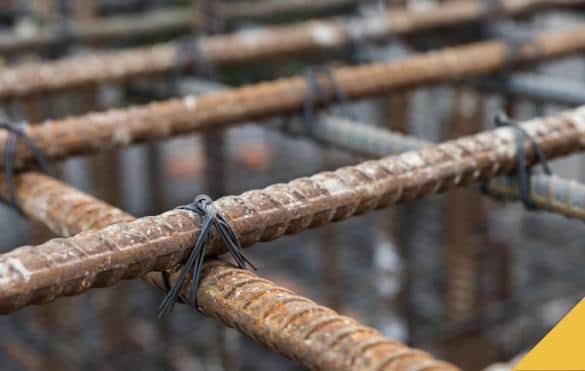
The reaction creates micro anodic zones, where iron dissolves, and cathodic zones, where oxygen is reduced. The end product — rust — occupies roughly seven times the volume of the steel consumed.
That expansion is the real problem. On bare steel it bursts the oxide layer and exposes fresh metal: corrosion feeds itself instead of slowing. In reinforced concrete it cracks the cover from within, opening a path for water and accelerating the process. It is the classic deterioration mechanism in coastal structures.
Why chlorides make everything worse
Chloride ions in sea air play two harmful roles: they make the electrolyte far more conductive, and they locally destabilise protective passive layers. They thereby enable pitting corrosion, deep and localised, far more dangerous than uniform rust: the loss of section is concentrated, and therefore invisible to a general inspection.
Corrosivity categories (EN ISO 12944)
EN ISO 12944-2 classifies environments by aggressiveness. It is the common language between designer, applicator and supplier — and the reference to cite in a specification.
| Category | Aggressiveness | Example environments |
|---|---|---|
| C1 | Very low | Heated interiors, offices, schools |
| C2 | Low | Unheated interiors; rural exteriors, low pollution |
| C3 | Medium | Urban areas; high-humidity interiors |
| C4 | High | Industrial areas; coastal with moderate salinity |
| C5 | Very high | Damp aggressive industry; coastal with high salinity |
| CX | Extreme | Offshore; highly aggressive tropical zones |
An outdoor structure in Greater Casablanca typically sits at C4, and at C5 directly on the seafront. The gap is not trivial: with an identical protection system, the time to first maintenance can be two to three times shorter between C3 and C5.
The practical consequence: a paint system specified for an inland urban site, applied unchanged to a coastal structure, will be under-specified. That is not an application defect, it is a specification error.
The three families of protection
1. Hot-dip galvanising (EN ISO 1461)
The finished part is immersed in molten zinc. Iron-zinc alloy layers form, metallurgically bonded to the steel — it is not a coating laid on top but a transformation of the surface. Hence its excellent resistance to impact and abrasion.
The standard ties minimum coating thickness to the thickness of the part: the thicker the steel, the heavier the coating required. That is logical — a thick part is generally a structural one, meant to last longer.
The decisive point: galvanising happens after fabrication, cutting and drilling included. Drilling a hole in a galvanised part opens a door to corrosion.
2. Paint systems (EN ISO 12944)
The standard sets out complete systems — surface preparation, primer, intermediate coats, finish — matched to a corrosivity category and a target durability.
The weak link is almost never the paint: it is surface preparation. A premium paint applied over mill scale or a greasy surface peels within a year. A modest system on a properly blasted substrate lasts.
3. The duplex system
Galvanising then paint. The durability achieved exceeds the sum of the two taken separately: the paint protects the zinc, which protects the steel wherever the paint is damaged. It is the solution for exposed coastal structures with a long design life.
Design mistakes that ruin good protection
Here is what makes properly treated structures fail anyway.
1. Water traps. An angle laid with its legs up forms a gutter. An open channel facing the sky holds water at every rainfall. The rule is simple: every horizontal surface must be sloped, drilled or oriented to drain.
2. Crevices. Two plates simply laid together create a capillary gap that water enters but does not leave. Starved of oxygen, that gap develops particularly aggressive crevice corrosion. A continuous weld, a sealant, or a generous clearance solves it.
3. The galvanic couple. Two different metals in contact and bridged by an electrolyte form a cell: the less noble one corrodes faster. A stainless screw in galvanised sheet attacks the zinc around it. The remedy: isolate the metals, or choose compatible fasteners.
4. Sharp edges. Paint naturally thins on a sharp edge, sometimes to half its nominal thickness. Corrosion starts there. Grinding the corners before painting takes seconds and changes the service life.
5. Sealed tubes without drainage. Condensation inside, never released, invisible corrosion. A drain hole at the low point settles it.
6. Contact with the ground. A post bedded at ground level corrodes exactly at the contact line, where moisture and oxygen alternate. Provide a plinth, a raised base plate, or a reinforced treatment over that zone.
Frequently asked questions
Why does steel rust faster on the coast?
Chloride ions in sea air make water far more conductive and destabilise protective passive layers. They enable pitting corrosion, deep and localised, more dangerous than uniform rust because the loss of section is concentrated.
What is a C4 or C5 corrosivity category?
They are classes defined by EN ISO 12944-2 according to environmental aggressiveness. C4 covers industrial areas and coastal sites of moderate salinity, C5 damp aggressive industry and high-salinity coastlines. An outdoor structure in Casablanca typically sits at C4, or C5 on the seafront.
Should galvanising be done before or after fabrication?
After fabrication, cutting and drilling included. Drilling or cutting an already galvanised part exposes bare steel and creates a starting point for corrosion.
Why does a quality paint sometimes peel within a year?
Almost always because of surface preparation. Paint applied over mill scale, rust or a greasy surface does not adhere durably, whatever its quality. A modest system on a properly blasted substrate will last far longer.
What is a duplex system?
Galvanising followed by a paint system. The durability achieved exceeds the sum of the two protections taken separately: the paint protects the zinc, and the zinc protects the steel wherever the paint is damaged.
The values given in this guide are theoretical benchmarks drawn from the standards cited. They do not replace a structural calculation note, nor the manufacturer's documentation. For any sizing, have your assumptions validated by a design office.