It is one of the most common questions at the counter, and the answer "take galvanised, it's stronger" is wrong on two counts: galvanising adds no mechanical strength, and it introduces constraints black sheet does not have. Here is how to decide, criterion by criterion.
What really separates them
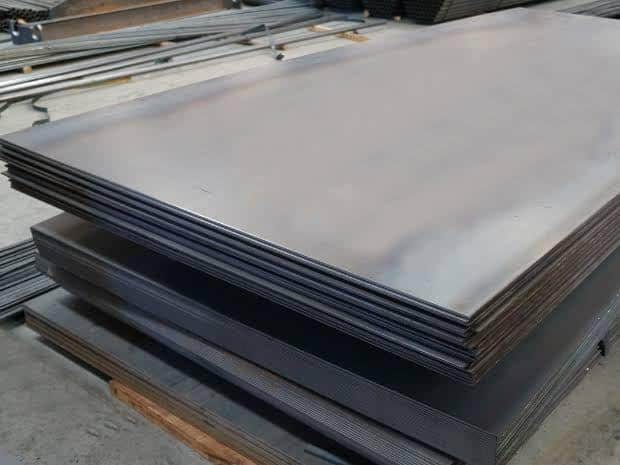
Black sheet is steel as rolled. Its dark grey tone comes from mill scale, an oxide layer formed on cooling. It has no lasting protection: left outdoors, it rusts within weeks.
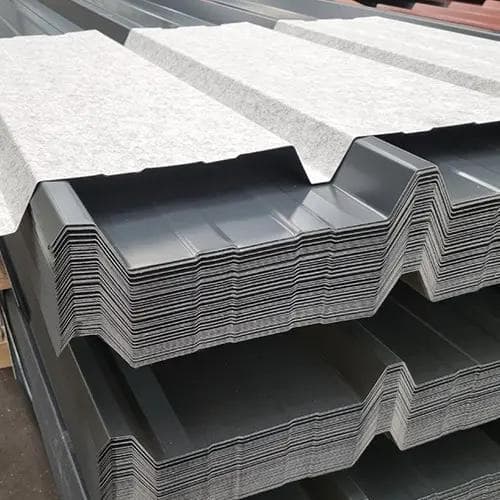
Galvanised sheet is the same steel, continuously zinc-coated at the mill. The coating is designated by a class to EN 10346 — Z100, Z140, Z200, Z275, Z350 — the number giving the zinc mass in grams per square metre, both faces combined.
The essential point: the base steel is the same. A galvanised sheet is no harder, no stronger and no stiffer than a black sheet of equal thickness and grade. What you buy with galvanising is durability in damp conditions, nothing else.
Welding and cutting: the advantage flips
This is where black sheet clearly takes the lead again.
Black sheet welds without particular constraints. Simply grinding the area to be joined is enough.
Galvanised sheet raises three welding problems:
- Fume. Zinc vaporises around 900 °C, well below arc temperature. Zinc oxide fume causes metal fume fever, a transient flu-like syndrome. Ventilation or extraction at source is essential.
- Weld quality. Vaporised zinc contaminates the weld pool and promotes porosity. The remedy is to strip the zinc from the weld zone beforehand.
- Protection destroyed. Around the bead, the coating is burnt away over several centimetres. That zone must be restored with a zinc-rich paint — otherwise corrosion starts precisely at the joint, which is the most highly stressed point.
The same logic applies to cutting: every cut leaves a bare steel edge. On thin sheet, galvanic protection from the neighbouring zinc covers that edge; on thick sheet it does not, and touch-up is required.
Painting: the classic trap
Many structures are painted after erection. The two substrates behave nothing alike.
On black sheet, paint adheres well once mill scale and rust have been removed. It is the simplest paint substrate there is.
On galvanised sheet, zinc is a smooth, passive, slightly alkaline surface: ordinary paint peels off in sheets within months. You need either a primer formulated for galvanised substrates, or to wait for the zinc to weather naturally, or to prefer pre-painted sheet — galvanised then coated at the mill, with adhesion far beyond anything achievable on site.
For structures that must both last and be painted, EN ISO 12944 sets out paint systems according to the corrosivity category of the environment. That is the reference to cite in a specification.
The decision rule
Choose black sheet if:
- the part stays indoors and dry;
- the structure involves a lot of welding;
- you will apply a full paint system anyway;
- thickness exceeds 3 mm — beyond that, hot-dip galvanising after fabrication is often more relevant than pre-galvanised sheet;
- the material budget is tight and the structure sheltered.
Choose galvanised if:
- the part is exposed to weather or permanent damp;
- assembly is by screwing, riveting or folding rather than welding;
- no maintenance is planned over the life of the structure;
- you are on the coast — and in that case, go up one coating class.
Casablanca deserves a mention: chloride-laden sea air accelerates corrosion markedly compared with an inland site. For any durable outdoor structure in Greater Casablanca, the question is generally not "should we protect", but "how thick a protection".
Frequently asked questions
Is galvanised sheet stronger than black sheet?
No. The base steel is identical: at equal thickness and grade, both sheets have exactly the same mechanical strength. Galvanising only adds durability against corrosion.
Can galvanised sheet be welded?
Yes, with three precautions: ventilate or extract the zinc oxide fume, strip the zinc from the weld zone to avoid porosity, and restore the protection after welding with a zinc-rich paint.
What does Z275 mean on a galvanised sheet?
It is a coating class to EN 10346: 275 grams of zinc per square metre, both faces combined. The higher the number, the thicker the coating and the longer the outdoor protection lasts.
Why does paint adhere poorly to galvanised sheet?
Zinc is a smooth, passive, slightly alkaline surface on which ordinary paint does not hold. You need a primer formulated for galvanised substrates, or should choose a mill pre-painted sheet directly.
The values given in this guide are theoretical benchmarks drawn from the standards cited. They do not replace a structural calculation note, nor the manufacturer's documentation. For any sizing, have your assumptions validated by a design office.