A sheet is ordered by dimension but paid for by the kilo. In between sits one multiplication — one every steel buyer should be able to do in their head, because it drives the material budget, the choice of lifting equipment and the cost of transport. This guide gives the formula, reference values for common formats, and above all the reasons why invoiced weight sometimes differs from calculated weight.
The formula, in one line
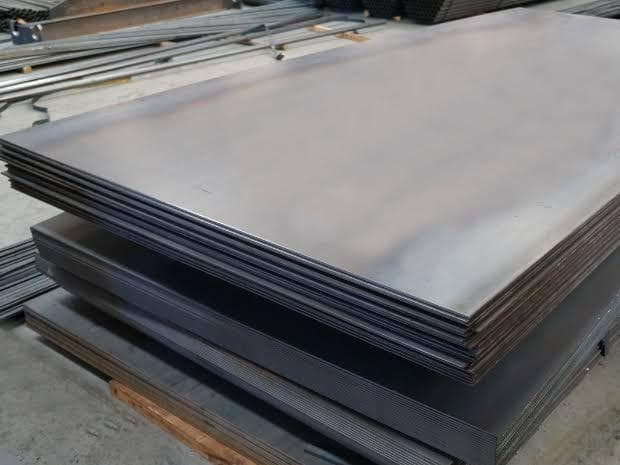
The weight of a rectangular sheet is calculated as follows:
Weight (kg) = Length (m) × Width (m) × Thickness (mm) × 7.85
Mind the units: the first two in metres, the thickness in millimetres. That mix surprises people at first, but it is deliberate — it avoids handling numbers with six decimal places.
Worked example on a 2,000 × 1,000 mm sheet in 3 mm:
- 2 × 1 × 3 × 7.85 = 47.1 kg
For a batch, simply multiply by the number of sheets. Ten identical sheets weigh 471 kg, under half a tonne: a standard forklift will do.
Where does 7.85 come from?
The density of structural steel is 7,850 kg/m³. One cubic metre of steel therefore weighs 7.85 tonnes.
Reduced to one square metre at one millimetre thick, that value becomes 7.85 kg. This is the number to remember: 1 m² of steel sheet at 1 mm weighs 7.85 kg. Everything else follows by proportion.
You will sometimes hear "call it 8" on site. The approximation is handy for a mental estimate, but it overstates weight by 1.9 %. On a 20-tonne order that is nearly 400 kg of difference: fine for a back-of-envelope figure, never for a quotation.
Weight of common formats
Below is the unit weight of the most requested formats. The "per m²" column lets you work out any non-standard format: multiply it by the area of your sheet.
| Thickness | Weight per m² | 2000 × 1000 | 2500 × 1250 | 3000 × 1500 | 6000 × 2000 |
|---|---|---|---|---|---|
| 1 mm | 7.85 kg | 15.7 kg | 24.5 kg | 35.3 kg | 94.2 kg |
| 1.5 mm | 11.78 kg | 23.6 kg | 36.8 kg | 53.0 kg | 141.3 kg |
| 2 mm | 15.70 kg | 31.4 kg | 49.1 kg | 70.7 kg | 188.4 kg |
| 3 mm | 23.55 kg | 47.1 kg | 73.6 kg | 106.0 kg | 282.6 kg |
| 4 mm | 31.40 kg | 62.8 kg | 98.1 kg | 141.3 kg | 376.8 kg |
| 5 mm | 39.25 kg | 78.5 kg | 122.7 kg | 176.6 kg | 471.0 kg |
| 6 mm | 47.10 kg | 94.2 kg | 147.2 kg | 212.0 kg | 565.2 kg |
| 8 mm | 62.80 kg | 125.6 kg | 196.3 kg | 282.6 kg | 753.6 kg |
| 10 mm | 78.50 kg | 157.0 kg | 245.3 kg | 353.3 kg | 942.0 kg |
| 15 mm | 117.75 kg | 235.5 kg | 367.9 kg | 529.9 kg | 1,413.0 kg |
| 20 mm | 157.00 kg | 314.0 kg | 490.6 kg | 706.5 kg | 1,884.0 kg |
Two useful markers: a 6,000 × 2,000 sheet in 10 mm exceeds 900 kg — it cannot be handled without lifting gear. And from 15 mm in large format you pass one tonne per sheet, which changes the unloading logistics.
Theoretical weight versus actual weight
The calculation above gives a theoretical weight. The weight on the weighbridge always differs slightly, for three reasons.
Thickness tolerances
A sheet sold as 3 mm is never exactly 3.000 mm. Product standards — EN 10029 for hot-rolled plate, EN 10051 for sheet cut from coil — allow a band around the nominal value.
The effect is purely proportional, and it bites hardest on thin gauges. A 3 mm sheet delivered at 3.2 mm weighs 6.7 % more than the theoretical figure. On a 5-tonne batch that is 333 kg appearing on the invoice.
Flatness and dimensional tolerances
Width and length have their own allowed bands too, generally on the generous side: a mill rarely delivers below the ordered format.
The coating
On galvanised sheet, the zinc adds to the steel. A Z275 class coating to EN 10346 means 275 g per square metre, both faces combined. On a 2 × 1 m sheet that is 0.55 kg of zinc — negligible on 5 mm material, but 3.5 % of the weight on a 1 mm sheet.
Where the formula is not enough
Chequered or ribbed plate. The raised pattern is material added to the base sheet. Count the weight of the plain thickness, plus the pattern allowance stated by the mill on its product sheet. Applying the formula to the total thickness measured at the top of the pattern gives too high a result.
Perforated sheet and expanded metal. Here it works the other way: material is removed. The actual weight equals the solid weight multiplied by the solid-area ratio. A sheet with 40 % open area weighs 60 % of the calculated figure.
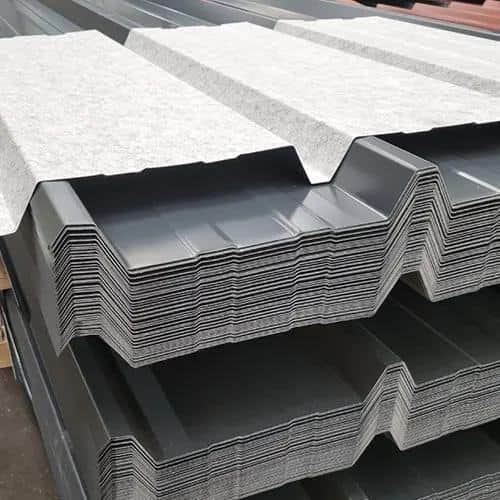
Profiled roofing sheet. The profile is formed by folding, with no material added or removed. Weight is therefore calculated on the developed width — the width of the strip before profiling — not on the cover width once installed. The gap between the two commonly reaches 15 to 25 %.
Cutting. If you have parts cut from a sheet, you pay for the whole sheet, offcuts included. Optimising the cutting plan before choosing the format is often the most immediate saving available.
Four recurring mistakes
- Mixing units. Entering the thickness in metres, or the lengths in millimetres, gives a result wrong by a factor of 1,000. If your answer looks absurd, this is almost always why.
- Using 7.85 for stainless or aluminium. Austenitic stainless sits around 7,900 to 8,000 kg/m³, aluminium around 2,700. An aluminium sheet weighs roughly a third of its steel equivalent.
- Forgetting rolling direction on rectangular formats. It has no bearing on weight, but it does on bending and cutting: state it when ordering.
- Quoting without margin. Between tolerances and offcuts, allowing 3 to 5 % above net requirement avoids a second order for a few kilos — always dearer per kilo than the first.
Frequently asked questions
How do you calculate the weight of a steel sheet?
Multiply length in metres by width in metres, by thickness in millimetres, then by 7.85. A 2,000 × 1,000 mm sheet in 3 mm weighs 2 × 1 × 3 × 7.85 = 47.1 kg.
How much does one square metre of steel sheet weigh?
7.85 kg per millimetre of thickness. One square metre of 2 mm sheet therefore weighs 15.7 kg, and one square metre of 10 mm weighs 78.5 kg.
Which steel density should be used in the calculation?
7,850 kg/m³ for common structural steels. The 8,000 kg/m³ approximation heard on site overstates weight by 1.9 %: acceptable for a quick estimate, best avoided in a quotation.
Why does the invoiced weight differ from my calculation?
Mainly because of the thickness tolerances allowed by EN 10029 and EN 10051. A 3 mm sheet delivered at 3.2 mm weighs 6.7 % more than the theoretical figure. On galvanised sheet, the zinc coating also adds weight.
Does the formula apply to chequered and perforated sheet?
Not directly. Chequered plate weighs more than its base thickness because of the raised pattern; perforated sheet weighs less, in proportion to its solid-area ratio. In both cases, refer to the mill's product sheet.
The values given in this guide are theoretical benchmarks drawn from the standards cited. They do not replace a structural calculation note, nor the manufacturer's documentation. For any sizing, have your assumptions validated by a design office.