Rebar is the most ordered product on a structural works site, and the most easily accepted without proper checking. Approximate diameter, poorly formed ribs, excessive rust: all defects visible to the naked eye — but only if you know what to look for. This guide gives the essential benchmarks.
What "high yield" means
Yield strength is the stress beyond which steel no longer returns to its original shape: it deforms permanently.
In a reinforced concrete structure, that value governs the design. Concrete takes compression, steel takes tension — and the quantity of steel required is inversely proportional to its yield strength. High-yield steel therefore allows smaller reinforcement sections for the same load capacity.
Two properties matter as much as strength:
- Ductility. Reinforcement must stretch before it breaks. That elongation is what makes a structure crack visibly before it fails — a warning signal. Steel that is too hard snaps clean, without warning.
- Weldability. It depends on chemical composition. Non-weldable steel that gets welded anyway loses its ductility in the heat-affected zone.
In Morocco, reinforcing steels fall under the Moroccan standards (NM) in force, published by IMANOR and broadly aligned with the European EN 10080 series. Always ask your supplier for the exact standard reference and the certificate of conformity: it is the only evidence that stands up to an inspection.
Weight by diameter: the table and its formula
Rebar is ordered by diameter and invoiced by weight. The conversion rests on a simple formula:
Linear mass (kg/m) = ز ÷ 162.2, with the diameter in millimetres.
That 162.2 is not arbitrary: it is the condensed form of π/4 × Ø² × 7,850 ÷ 10⁶ — the area of the round multiplied by the density of steel.
| Diameter | Area | Linear mass | 12 m bar | Metres per tonne |
|---|---|---|---|---|
| Ø 6 | 28.3 mm² | 0.222 kg/m | 2.66 kg | 4,505 m |
| Ø 8 | 50.3 mm² | 0.395 kg/m | 4.74 kg | 2,532 m |
| Ø 10 | 78.5 mm² | 0.617 kg/m | 7.40 kg | 1,621 m |
| Ø 12 | 113.1 mm² | 0.888 kg/m | 10.66 kg | 1,126 m |
| Ø 14 | 153.9 mm² | 1.208 kg/m | 14.50 kg | 828 m |
| Ø 16 | 201.1 mm² | 1.578 kg/m | 18.94 kg | 634 m |
| Ø 20 | 314.2 mm² | 2.466 kg/m | 29.59 kg | 406 m |
| Ø 25 | 490.9 mm² | 3.854 kg/m | 46.25 kg | 259 m |
| Ø 32 | 804.2 mm² | 6.313 kg/m | 75.76 kg | 158 m |
The "metres per tonne" column is the most useful when preparing an order: it takes you straight from a reinforcement take-off to a tonnage to order.
One order of magnitude worth keeping in mind: doubling the diameter quadruples the weight. A Ø20 weighs four times a Ø10, because area varies with the square of the diameter.
The ribs: the part that does all the work
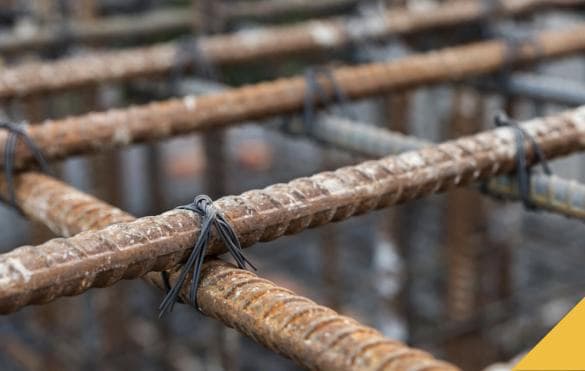
The raised ribs on a bar's surface are not decorative. They create the mechanical bond between steel and concrete.
Without them, a plain bar is held in concrete by friction alone — a weak link that lets go at the first crack. The ribs, by contrast, bear physically against the hardened concrete: the force transfers by bearing, not friction.
That is why rib geometry is standardised: height, spacing and inclination directly govern the anchorage and lap lengths calculated by the design office. A bar whose ribs are flattened, poorly formed or too widely spaced does not deliver the bond assumed in the calculation, even if its diameter and grade are compliant.
On delivery, two visual checks eliminate most problems: the ribs must be sharp, regular and present along the full length, and the mill's rolled-in marking must be legible on the bar.
Receiving a delivery: the checklist
- Actual diameter. Measure with callipers between the ribs, not over them. Better still: weigh a known length and compare with the table. A bar sold as Ø12 weighing 0.80 kg/m instead of 0.888 is 10 % short on area — a shortfall paid for in strength.
- Marking. The producer and grade must be identifiable on the bar.
- Documents. Certificate of conformity and standard reference must accompany the delivery.
- Surface condition. Light, powdery rust is harmless — it even slightly improves bond. Flaking rust that comes away in plates, however, signals a loss of area: reject the bar.
- Straightness. Bars must be straight. A bar straightened after bending has been locally work-hardened and has lost ductility.
Storage on site
Never lay reinforcement directly on the ground. Raise it on timbers and, on the coast, sheet it over: chlorides in sea air start a corrosion process that carries on inside the concrete after pouring. It is one of the main causes of premature deterioration in coastal structures.
Frequently asked questions
What does high-yield mean for rebar?
The stress beyond which the steel deforms permanently is high. That allows smaller reinforcement sections for the same load capacity, provided ductility and weldability remain compliant.
How much does a 12 mm rebar weigh?
0.888 kg per metre, so 10.66 kg for a 12 m bar. The general formula is ز ÷ 162.2, with the diameter in millimetres.
How many metres of Ø10 rebar in a tonne?
About 1,621 metres. A Ø10 weighs 0.617 kg/m: 1,000 ÷ 0.617 = 1,621 m.
What are the ribs on a reinforcing bar for?
They create the mechanical bond with the concrete. Force transfers by bearing against the hardened concrete, not by simple friction. Their geometry is standardised because it determines anchorage and lap lengths.
Can a rusty bar be used?
Light, powdery rust is harmless and even slightly improves bond. Flaking rust that comes away in plates, however, indicates a loss of area: the bar must be rejected.
The values given in this guide are theoretical benchmarks drawn from the standards cited. They do not replace a structural calculation note, nor the manufacturer's documentation. For any sizing, have your assumptions validated by a design office.